
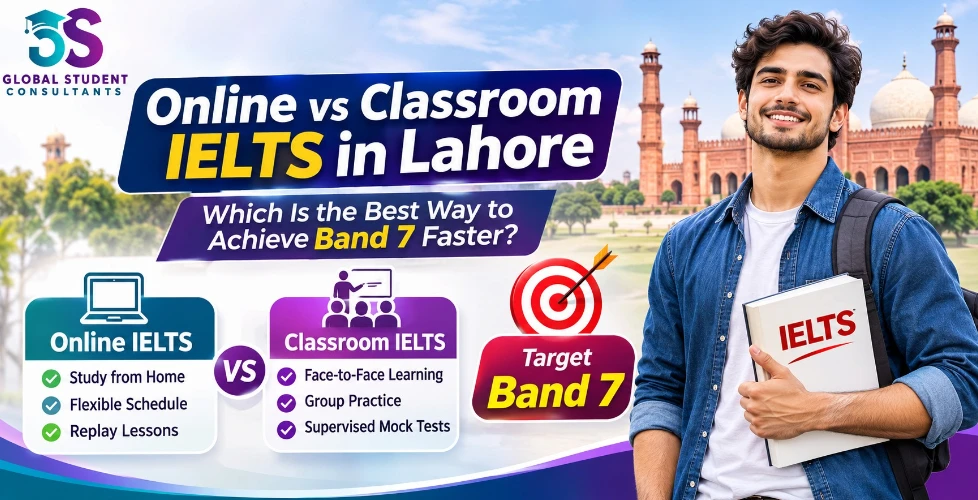
Preparing for IELTS is an important step for students planning to study, work, or settle abroad. However, before starting your preparation, one question often creates confusion: should you join an online IELTS course or attend physical classroom sessions?
Imagine two students in Lahore working towards the same goal: achieving an IELTS Band 7. One attends regular classes at an academy, spending time travelling through busy city traffic. The other studies online from home, attending virtual lessons and practising Listening exercises whenever convenient. Both are equally determined, but their learning experiences are completely different.
So, which student is more likely to achieve Band 7 first?
The answer is not simply online or classroom learning. Your progress depends on the quality of teaching, regular practice, individual feedback, and your ability to remain consistent throughout the preparation period.
At GS Consultant, we believe that choosing the right learning environment is just as important as following an effective IELTS preparation strategy. This guide compares online and classroom IELTS preparation in Lahore to help you select an option that matches your learning style, daily routine, and target score.
Online IELTS vs Classroom IELTS: A Quick Comparison
Before examining both learning methods in detail, let’s look at their main differences.
Online IELTS Preparation
- Attend lessons from your home or any convenient location
- Save travelling time and transportation expenses
- Access recorded lectures and revisit difficult topics
- Organise your preparation around work, university, or personal commitments
- Practise Listening and Reading using online resources
- Requires personal discipline and a reliable internet connection
Classroom IELTS Preparation
- Follow a structured timetable and fixed learning routine
- Communicate directly with instructors and fellow students
- Participate in face-to-face Speaking activities
- Complete supervised practice tests
- Learn through classroom discussions and group exercises
- Requires regular attendance and travelling to the academy
Our recommendation: Neither learning method guarantees Band 7. The best option is the one that provides regular practice, personalised corrections, experienced instruction, and enough opportunities to improve your weak areas. In some cases, combining online and classroom learning can produce an effective preparation routine.
Which Learning Method Helps You Reach Band 7 Faster?
The time required to achieve IELTS Band 7 varies from student to student. Someone starting at Band 6.5 may need considerably less preparation than someone currently scoring Band 5.0. Consider two hypothetical candidates:
Student A – Online preparation. This student attends live online lessons, submits Writing assignments every week, receives individual feedback, and participates in regular Speaking sessions. Recorded lessons help them revise difficult topics whenever necessary.
Student B – Classroom preparation. This student attends physical classes, participates in group discussions, completes timed mock examinations, and receives corrections from an instructor. The classroom environment helps maintain a consistent study schedule.
Both students can achieve Band 7 if their preparation is effective. However, a third student who attends lessons without submitting essays for correction or practising Speaking regularly may continue repeating the same mistakes.
The important lesson is simple: regularly corrected practice is more valuable than simply attending classes.
These examples are illustrative. Actual IELTS results depend on starting proficiency, preparation time, teaching quality, and individual performance.
Online vs Classroom IELTS: Complete Comparison
Choosing between virtual and physical classes requires more than comparing their convenience. You should consider how each format affects your learning experience and examination performance.
| Comparison factor | Online IELTS | Classroom IELTS |
|---|---|---|
| Flexibility | Convenient study schedules | Fixed class timings |
| Travelling | No daily commute | Requires transportation |
| Speaking practice | Effective through live video sessions | Direct face-to-face interaction |
| Writing feedback | Depends on instructor response time | Depends on marking quality |
| Mock tests | Available through online platforms | Can include supervised examinations |
| Study routine | Requires self-management | Provides a structured schedule |
| Learning environment | Home-based study | Dedicated classroom |
| Missed lessons | Recordings may be available | Depends on make-up arrangements |
| Internet requirements | Requires stable connectivity | Usually not required for regular lessons |
| Group interaction | Virtual discussions | In-person communication |
Which Format Offers More Flexibility?
Online IELTS preparation is particularly useful for students managing university, employment, internships, or family responsibilities. You can attend lessons without travelling across Lahore and use the saved time for additional practice. Classroom courses generally follow predetermined schedules. Although this arrangement may be inconvenient for some students, it creates a regular learning routine.
Winner: Online IELTS preparation, especially for students with demanding schedules.
Which Format Provides Better Speaking Practice?
Speaking is one of the most important parts of IELTS preparation. Candidates must communicate clearly, organise their thoughts, and respond naturally to different questions.
Classroom learning provides opportunities to interact directly with teachers and other candidates. Students can practise conversations, participate in discussions, and become comfortable speaking English in front of others. However, online courses can also provide effective Speaking preparation when they include small live groups, individual speaking assessments, and regular instructor feedback.
Winner: Classroom learning for direct interaction, although a well-organised online programme can deliver comparable practice.
Which Format Is Better for IELTS Writing?
Writing requires more than learning essay structures and memorising vocabulary. Candidates must understand task requirements, organise ideas, use appropriate grammar, and develop arguments effectively. Online and classroom programmes can both provide excellent Writing preparation. What matters most is whether your instructor:
- Reviews your Task 1 and Task 2 responses
- Identifies grammatical and vocabulary mistakes
- Explains problems with task achievement and coherence
- Provides practical recommendations for improvement
- Allows you to rewrite essays after receiving feedback
Winner: Both formats, provided students receive detailed and regular corrections.
Which Format Is Better for Mock Tests?
Mock examinations help candidates understand the IELTS test structure, manage time, and identify areas requiring improvement. Classroom academies may provide supervised mock tests that recreate examination conditions. Online programmes can also conduct full-length timed assessments, although the level of supervision varies. Before enrolling, ask whether the academy offers complete Listening, Reading, Writing, and Speaking assessments.
Winner: Classroom learning for supervised examination practice, while online mock tests remain useful for independent preparation.
How to Calculate Your IELTS Preparation Progress
Instead of focusing entirely on the learning format, consider three important elements that influence your progress.
1. Practice Hours
Your preparation should include consistent Listening, Reading, Writing, and Speaking activities. Watching lectures without completing exercises is unlikely to produce significant improvement.
2. Quality of Feedback
Feedback helps you recognise mistakes that may otherwise become permanent habits. Regularly reviewing corrected essays and Speaking assessments can make your preparation more productive.
3. Consistency
Studying regularly is more effective than completing several hours of preparation one day and doing nothing for the next week.
A simple way to understand your progress is:
Preparation Progress = Practice Hours × Feedback Quality × Consistency
This is a conceptual learning model, not a scientific score prediction formula. It highlights why all three elements are important. Your starting IELTS level also matters. Improving from Band 5.5 to Band 7 usually requires more development than moving from Band 6.5 to Band 7.
Which IELTS Format Is Better for Each Skill?
IELTS assesses four language abilities. Each requires a slightly different preparation strategy, so choosing a course that covers all four skills is essential.
1. IELTS Listening
Online learning can be particularly convenient. Students can listen to recordings multiple times, pause difficult sections, review explanations, and practise different question types. Useful preparation activities include:
- Listening to conversations and academic discussions
- Identifying keywords and specific information
- Practising multiple-choice questions
- Understanding different English accents
- Reviewing incorrect answers
You can also explore our IELTS Listening tips to improve your listening accuracy.
2. IELTS Reading
Both learning formats can support IELTS reading preparation, but online practice offers additional convenience. Students can complete timed reading passages, identify unfamiliar vocabulary, and review incorrect answers independently. Focus on:
- Skimming and scanning techniques
- True, False, Not Given questions
- Matching headings
- Identifying specific information
- Managing examination time effectively
3. IELTS Writing
The quality of instructor feedback matters more than the classroom environment. Academic candidates need to prepare Task 1 and Task 2, while General Training candidates must practise the relevant letter-writing and essay formats. Regularly submit your work for evaluation and pay attention to:
- Task Achievement or Task Response
- Coherence and Cohesion
- Lexical Resource
- Grammatical Range and Accuracy
Never rely entirely on memorised essays. Understanding how to develop relevant ideas is essential.
4. IELTS Speaking
Live interaction is essential for developing Speaking confidence. Candidates should practise all three parts of the Speaking examination:
- Part 1: Introduction and familiar questions
- Part 2: Individual long-turn speaking using a cue card
- Part 3: Discussion of broader and more abstract topics
Practising with an instructor or study partner helps you improve fluency, pronunciation, vocabulary, and confidence. If you struggle with everyday English conversations, joining spoken English classes before or alongside IELTS preparation may also be beneficial. For practical advice, see these IELTS speaking tips.
Our suggestion: Use independent online resources for Listening and Reading, but make sure your preparation includes regular live Speaking practice and individually corrected Writing assignments.
Which IELTS Learning Format Matches Your Personality?
Your personal learning habits can help determine whether online or classroom preparation is more suitable.
Choose Online IELTS If You:
- Have a busy university or professional schedule
- Live far from your preferred IELTS academy
- Prefer studying in a comfortable environment
- Can manage your study timetable independently
- Feel confident participating in online discussions
- Want to save commuting time and expenses
For these students, online IELTS preparation can provide the flexibility needed to maintain consistent progress.
Choose Classroom IELTS If You:
- Find it difficult to study without supervision
- Prefer direct communication with instructors
- Learn better through group activities
- Need regular reminders to complete assignments
- Feel nervous speaking English in front of others
- Prefer a fixed timetable and dedicated learning space
A classroom environment can provide the structure and interaction needed to maintain motivation.
Is a Combination of Both Better?
For some candidates, a blended preparation strategy offers the advantages of both learning formats. For example, you can:
- Attend classroom sessions for Speaking activities
- Use online lessons to revise difficult topics
- Complete Listening and Reading exercises at home
- Submit Writing assignments electronically
- Attend supervised mock examinations regularly
This approach allows students to benefit from structured teaching without losing the flexibility of independent study.
Common Myths About Online and Classroom IELTS Preparation
Several misconceptions can influence students when selecting an IELTS academy. Let’s examine some of the most common ones.
Myth 1: Classroom IELTS preparation always produces better results.
Reality: Physical attendance does not automatically improve your English proficiency. A classroom course is effective when instructors provide individual attention, meaningful practice, and regular corrections.
Myth 2: Online IELTS courses are easier.
Reality: Online learning requires discipline. Without a proper timetable, students may postpone lessons and fail to complete their assignments.
Myth 3: Joining a famous IELTS academy guarantees Band 7.
Reality: An academy’s reputation cannot guarantee your examination result. Your progress depends on your existing English skills, preparation strategy, instructor quality, and practice routine.
Myth 4: Watching recorded IELTS lectures is enough.
Reality: Recorded lessons are useful for understanding examination techniques, but they cannot replace personalised Writing corrections and live Speaking assessments.
Myth 5: More study hours always mean a higher band.
Reality: Practising incorrect techniques repeatedly may reinforce mistakes. Effective preparation requires reviewing errors and applying corrections.
How to Make the Most of Online IELTS Preparation
If you decide to study online, follow these recommendations to maintain an effective routine.
- Create a dedicated study spaceSelect a quiet location where you can concentrate without unnecessary interruptions.
- Follow a fixed timetableAssign specific hours to each IELTS skill instead of studying whenever you find free time.
- Participate in live lessonsAsk questions, communicate with instructors, and practise Speaking regularly.
- Submit Writing assignmentsRequest detailed feedback instead of relying exclusively on automated checking tools.
- Practise with headphonesThis can help you concentrate on Listening recordings.
- Prepare a backup internet connectionAvoid interruptions during important classes and mock tests.
- Maintain an error notebookRecord repeated grammar, vocabulary, pronunciation, and comprehension mistakes.
How to Make Classroom IELTS Preparation More Effective
Physical classes can provide an excellent learning environment, but students should actively participate to get the best results. Consider following these practices:
- Attend every scheduled sessionRegular attendance helps you maintain continuity.
- Participate in classroom discussionsPractise speaking instead of allowing other students to answer every question.
- Ask instructors for clarificationDiscuss difficult topics immediately rather than leaving them unresolved.
- Use commuting time productivelyListen to English podcasts or IELTS recordings when travelling safely as a passenger.
- Review corrected essaysRewrite your assignments after understanding the instructor’s comments.
- Practise outside the academyClassroom sessions should support your independent preparation, not replace it.
- Record your Speaking practiceListen to your answers and identify areas where you need improvement.
Seven Questions to Ask Before Joining an IELTS Academy in Lahore
Selecting an IELTS academy in Lahore is an important decision. Before paying registration or course fees, make sure you understand what the programme actually offers. Ask the academy these seven questions:
- How many students are enrolled in each batch?Smaller groups can provide more opportunities for individual attention and Speaking practice.
- Who evaluates Writing assignments?Ask whether experienced instructors personally review essays and how long students usually wait for feedback.
- How frequently are Speaking sessions conducted?A good preparation programme should provide regular opportunities to practise speaking with instructors or other candidates.
- Are complete mock examinations included?Find out whether the academy conducts full-length Listening, Reading, Writing, and Speaking assessments.
- Can I review sample student feedback?A sample corrected essay can help you understand the quality of instruction and evaluation.
- What happens if I miss a lesson?Check whether recorded lectures, alternative sessions, or make-up classes are available.
- What is the complete course fee?Ask for a breakdown of registration charges, tuition, study materials, mock examinations, and any additional expenses.
Comparing these details will help you make an informed decision rather than selecting an institute based entirely on advertising or discounted fees. You can also review the top 10 IELTS institutes in Lahore to build your shortlist.
Why IELTS Band 7 Matters for Studying Abroad
IELTS is widely accepted by universities and educational institutions in English-speaking countries. Many international students need to demonstrate their English proficiency before receiving admission. Although Band 7 is not compulsory for every programme, achieving this score may help students satisfy the language requirements of a wider range of academic opportunities. Here are four important reasons to work towards a strong IELTS result.
1. University Admission
Many universities require international applicants to provide evidence of English proficiency. The required IELTS score depends on the institution, degree level, subject, and programme. Some courses may require an overall Band 6.5, while others may expect Band 7 or higher. Always verify the current requirements of your selected university.
2. Visa and Immigration Requirements
Certain immigration and visa pathways require applicants to demonstrate English proficiency through an approved language examination. The accepted tests and minimum scores differ between countries and visa categories. Students should check the latest official immigration requirements before booking an examination.
3. More Educational Opportunities
A higher IELTS score may help applicants meet the language requirements of additional universities and competitive academic programmes. However, IELTS results do not guarantee admission, scholarships, or visa approval. Academic qualifications and other eligibility requirements remain important.
4. Better Communication Abroad
English proficiency is useful beyond the examination hall. Students need to understand lectures, participate in group projects, communicate with classmates, and manage everyday situations. The language skills developed during IELTS preparation can support a smoother transition into an international academic environment.
If Band 7 is your target, understand what an IELTS Band 7 represents and identify the areas where your current performance needs improvement.
Is IELTS Difficult to Pass?
IELTS does not have a conventional pass-or-fail system. Candidates receive individual scores for Listening, Reading, Writing, and Speaking, along with an overall band score. Whether the examination feels difficult depends on your current English proficiency and the score required by your university or immigration pathway.
For example, someone targeting Band 6 may follow a different preparation strategy from a candidate who needs Band 7.5. The best way to understand your current position is to complete a diagnostic test and identify your weakest skills before beginning an intensive preparation programme.
Four Phases to Build Your IELTS Band 7 Preparation Strategy
A structured preparation plan can help you organise your learning and measure progress. Instead of following an unrealistic fixed timeline, focus on completing these four stages.
- Evaluate your current English levelBegin with a complete IELTS mock examination. Evaluate your performance in all four skills and identify the areas where you lose marks. Also record a Speaking response to assess your fluency, pronunciation, and ability to organise ideas.
- Improve your weakest skillsIf Listening is difficult, practise identifying specific information and understanding different accents. If Reading is challenging, improve skimming, scanning, and time management. If Writing is weak, work on essay organisation, grammar, and task requirements. If Speaking is difficult, practise answering questions naturally and confidently.
- Develop examination techniquesAfter improving your basic language skills, begin practising under timed conditions. Focus on completing Reading passages within the allocated time, planning Writing responses efficiently, and answering Speaking questions without unnecessary hesitation.
- Complete mock tests and review your performanceTake regular full-length mock examinations and compare your results. Do not book your official IELTS test simply because you achieve your target score once. Look for consistent performance across several reliable practice examinations.
Remember that mock test results are indicators of preparation, not guarantees of your official IELTS score.
Five Mistakes That Can Delay Your IELTS Band 7 Goal
Many candidates spend months preparing for IELTS without making the progress they expect. In several cases, the problem is not the examination itself but the way they approach preparation. Avoid these five common mistakes.
1. Selecting an Academy Only Because of Low Fees
Affordable courses can be useful, but the lowest price should not be your only consideration. Check instructor experience, batch size, feedback quality, and included mock examinations.
2. Ignoring Writing Corrections
Writing requires continuous improvement. If you repeatedly submit essays without receiving meaningful feedback, you may continue making the same grammatical and structural mistakes.
3. Avoiding Speaking Practice
Some students spend most of their preparation time on Listening and Reading because these skills feel easier to practise independently. However, avoiding Speaking can affect confidence and performance.
4. Changing Preparation Methods Too Frequently
Switching between different academies, online courses, books, and study plans can interrupt your learning routine. Select a suitable strategy and follow it consistently.
5. Booking the Examination Too Early
One successful mock test does not necessarily indicate that you are ready. Your performance should remain consistent across several complete practice examinations.
An additional tip: maintain an IELTS error log. Keep a notebook or digital document containing the mistakes you make during preparation, and review it regularly. It will help you recognise recurring problems and measure your improvement. Include:
- Incorrect vocabulary and its appropriate alternatives
- Grammatical errors and corrected sentences
- Repeated Listening mistakes
- Reading question types that cause difficulty
- Pronunciation issues identified during Speaking practice
- Feedback received on Writing assignments
Frequently Asked Questions About Online and Classroom IELTS in Lahore
Can I achieve IELTS Band 7 through online preparation?
Yes. Online IELTS preparation can help you achieve Band 7 if you follow a structured learning plan, attend live classes, complete regular practice tests, and receive individual feedback on Writing and Speaking. The learning format itself does not determine your final band score.
How long does it take to achieve IELTS Band 7?
There is no fixed preparation period for every candidate. Your current English proficiency, previous IELTS score, daily practice hours, and learning consistency all influence the time required. A student starting at Band 6.5 may need less preparation than someone beginning at Band 5.0.
Is online IELTS preparation cheaper than classroom learning?
Online courses may reduce transportation and other commuting expenses. However, tuition fees vary between academies and programmes. Compare the complete course costs, including study materials, mock examinations, and additional services, before making a decision.
Do I need IELTS to study abroad?
Not every international university or programme requires IELTS. Some institutions accept alternative English proficiency examinations or provide exemptions to eligible applicants. Always check the language requirements of your chosen university and programme.
Which is better for IELTS Speaking: online or classroom classes?
Classroom sessions provide direct face-to-face interaction, while online programmes offer live video conversations. Both can be effective when students receive sufficient speaking time, individual corrections, and opportunities to practise all three parts of the IELTS Speaking examination.
Should I join an online or classroom IELTS academy in Lahore?
Your decision should depend on your learning preferences, schedule, available resources, and need for supervision. Choose online learning if flexibility is your priority. Consider classroom preparation if you need a structured environment and direct interaction with instructors. You can also combine both methods to develop a balanced preparation routine.
Final Thoughts
The right IELTS preparation method is the one that helps you improve consistently and correct your weaknesses before the official examination.
Online learning offers convenience, flexibility, and opportunities for independent revision. Classroom preparation provides structure, face-to-face interaction, and a dedicated learning environment. Neither option automatically produces a higher IELTS score.
Before enrolling, evaluate your current English proficiency, compare available courses, ask about Writing feedback, and make sure you will receive sufficient Speaking practice and regular mock examinations.
At GS Consultant, we understand that every student has different academic goals, preparation needs, and plans for studying abroad. Our aim is to help students make informed decisions about IELTS preparation and their international education journey. Whether you prefer online learning or traditional classroom sessions, start with an accurate assessment of your English level and a preparation strategy designed around your target score. If you want a second opinion, speak with professional study abroad consultants.
Your journey towards IELTS Band 7 begins with the right preparation, consistent effort, and expert guidance.
IELTS formats, fees, score requirements and acceptance rules can change. Always confirm the latest details with the official IELTS provider, your university and the relevant visa authority before booking.