
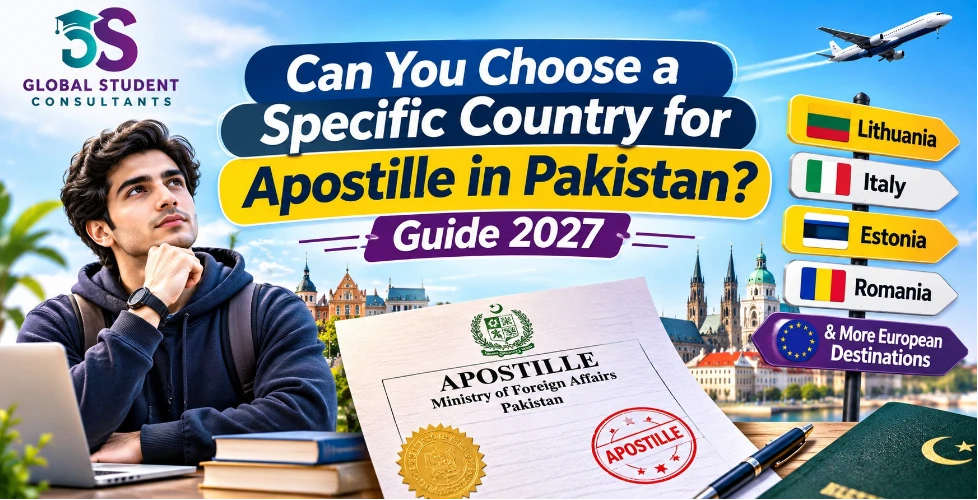
Planning to study in Lithuania, Italy, Estonia, Romania or another European country? Then you have probably asked yourself whether every destination needs its own Apostille.
In many cases, one Apostille from Pakistan’s Ministry of Foreign Affairs (MOFA) can be used in several Hague Convention countries, as long as the Convention is in effect between Pakistan and the country concerned. There are some important exceptions, though, and Pakistani students should know them before they hand over their documents.
In this guide, GS Consultants explains how the Apostille process works in Pakistan, whether the country you pick on the MOFA form matters, how much time to allow, which documents normally need attestation first, and which countries objected to Pakistan joining the Convention.
Does the Country You Choose Limit Your Apostille?
No. The MOFA Apostille form does ask you to pick a destination country, but your choice does not tie the Apostille to that country alone.
Say you are applying to universities in Lithuania, Estonia and Italy. You normally do not need three Apostilles. You choose one destination on the form, receive one Apostille for the document, and can generally use it in other Hague Convention countries where the Convention applies with Pakistan. The destination named on the MOFA form does not narrow where the Apostille is valid.
Keep in mind: an Apostille verifies the signature, the position of the person who signed, and the seal or stamp on a public document. It does not confirm that the details written in the document are correct.
Even so, the university, immigration office or embassy that receives your file may ask for more:
- Certified translations
- Original documents
- Notarised copies
- Further attestations
- A particular document format
- Its own verification process
Read the document rules of your specific university and destination country before you start.
How Much Time Does a Pakistani Apostille Take?
The timeline depends on how busy MOFA is, how long document verification takes and what kind of document you have. Many students plan for roughly 30 days, and some applications run longer. In some recent cases handled by GS Consultants, the process finished in about 15–20 days as of November 2026. This comes from our own experience and is not an official MOFA promise.
Plan for the whole chain, not just the MOFA step. Educational documents may first need:
- Board verification
- IBCC attestation
- HEC attestation, where it applies
- MOFA Apostille
- Translation, if required
- Submission to the university or visa office
Do not leave this until the final weeks before your admission or visa deadline.
Why Is an Apostille Needed?
An Apostille lets an overseas authority confirm that a Pakistani public document is genuine. A foreign university or government office usually cannot check a Pakistani signature or official seal by itself, so the Apostille gives it an internationally accepted form of authentication under the Hague Apostille Convention.
What an Apostille confirms
- The signature on the document is authentic
- The role in which the signer acted
- The identity of the seal or stamp on the document
What it does not confirm
It does not prove that every statement in the document is accurate, and it does not automatically stand in for certified translation, university checks, notarisation, academic equivalency or other immigration conditions. If your university asks for an Apostille, sending a document without one can lead to delays or follow-up requests.
Attestation and Apostille: How Do They Differ?
Many Pakistani students mix the two up, but they are different steps.
Attestation
Attestation is usually done inside Pakistan before the document goes to MOFA. Matric and Intermediate certificates may need board verification and then IBCC attestation, university degrees and transcripts typically need HEC attestation, and other civil documents have their own verification route. For the full process, read our IBCC verification guide.
Apostille
MOFA issues the Apostille once the document has completed the earlier verification or attestation. It authenticates the official signature and seal so the document can be accepted under the Hague Apostille system.
Verify or attest first → apply for the MOFA Apostille → submit to the foreign university or authority. One step does not normally replace the other.
Which Documents Usually Need an Apostille?
What you need depends on the university, the visa office and the destination country. These are the documents Pakistani students most often run into:
| Document | Step before MOFA | Lithuania | Romania |
|---|---|---|---|
| Matric & Intermediate certificates | Board verification, then IBCC attestation | Yes, for bachelor’s applicants | Yes |
| Degrees & transcripts | HEC attestation | Yes | Yes |
| Police Character Certificate | Issued by the relevant police authority; confirm whether MOFA needs anything extra | Often needed for the residence permit | Ask the university or authority |
| Birth certificate | A NADRA-issued document may go through the applicable MOFA route | Not usually a standard student requirement | Needed in relevant cases |
| Marriage certificate / Nikkah documents | Marriage Registration Certificate and CNIC requirements may apply | Mostly for spouse applications | Where applicable |
Romania
If you plan to study in Romania, give extra thought to your civil documents. A birth certificate can form part of the admission file, and you may also need an Apostille and a legalised translation, depending on the university and the immigration process. Follow the instructions given by your Romanian university and the relevant authorities.
Is a One-Day Apostille Possible?
In general, no. Educational documents normally have to be verified or attested before reaching MOFA, and the process itself has several stages:
- Finishing the relevant educational attestation
- Registering on the MOFA Apostille system
- Submitting your application and waiting for approval
- Getting the payment challan and paying the fee
- Attending the chosen MOFA office on your assigned date
- Collecting the Apostilled documents
With all these stages, it is unwise to plan around a one-day service.
What Does an Apostille Cost in Pakistan?
As per the MOFA Consular Services information on Apostille services, the fees are:
- Personal and educational documents: Rs. 3,000 per document
- Legal documents: Rs. 4,500 per document
- Commercial documents: Rs. 12,000 per document
HEC and IBCC fees are charged separately, and an authorised courier company may add its own courier or service charges. Government fees can change, so confirm the current amount before you submit.
Is the Apostille Application Fully Online?
It starts online, but the whole process is not online from start to finish. MOFA asks applicants to register online before they submit an Apostille request, and from 27 July 2026 requests without prior online registration are not accepted.
- Make an account.Sign up on the MOFA Apostille portal and fill in your personal details.
- Upload your documents.Add the required documents along with your CNIC information.
- Pick your destination country.Choose one of the countries you plan to use the document in.
- Wait for MOFA to approve.After approval, the payment challan is issued to you.
- Pay the fee.Follow the directions printed on your challan.
- Go to the selected MOFA office.Attend on the date given and collect your Apostilled documents.
MOFA also provides options through authorised courier companies, which may let you use courier services instead of handling every stage in person. For the newest procedure, always read the official MOFA instructions before you apply.
Why Can One Apostille Serve Several European Countries?
The answer is the Hague Apostille Convention, which sets up a simpler way for member countries to accept each other’s public documents. In place of embassy legalisation for every destination, one Apostille can authenticate a document for use in another member country where the Convention applies. According to the information used in this guide, the Convention has 130 contracting parties, and Pakistan and several popular European study destinations are among them.
| Country | Hague Apostille Convention | Convention in force |
|---|---|---|
| Pakistan | Yes | 9 March 2023 |
| Estonia | Yes | 30 September 2001 |
| Italy | Yes | 11 February 1978 |
| Lithuania | Yes | 19 July 1997 |
This means Pakistani students applying to Lithuania, Estonia and Italy generally do not need an extra Apostille for each one. The same logic can extend to other Hague Convention countries such as France, Spain, Ireland, Portugal, Belgium and Sweden, but always check the present status between Pakistan and your destination, since membership by itself does not tell you everything.
A Key Exception: Countries That Objected to Pakistan
Pakistan belongs to the Hague Apostille Convention, yet some countries have objected to its accession. The countries named in the relevant HCCH notifications include:
- Germany
- Austria
- Finland
- Czech Republic
- Poland
- Netherlands, including Aruba, Curaçao and Sint Maarten
- Denmark
- Greece
Between Pakistan and an objecting country, the Convention does not work in the usual way, so never assume a Pakistani Apostille will be enough there. Find out the current legalisation rules from the relevant embassy, university or authority before you start.
Lithuania, Italy and Estonia are not on the list
These countries did not object to Pakistan’s accession, so when the receiving authority wants authentication, a Pakistani Apostille can generally be used there under the Convention.
Apostille Requirements for Lithuania
Lithuania is a member of the Hague Apostille Convention and did not object to Pakistan joining. Pakistani students who want to study in Lithuania may therefore need Apostilled educational documents when their university or immigration process asks for them. The usual documents are the final educational certificate, degree, academic transcript and other supporting public documents where specifically requested. Bachelor’s applicants may also need their school certificates verified and attested.
A common sequence: Board/IBCC or HEC attestation → MOFA Apostille → University/visa submission.
Do not assume all Lithuanian universities follow the same policy. Some accept scanned documents at the admission stage but ask for originals or properly authenticated documents at registration. And the Apostille is only one piece of the wider Lithuanian study visa and residence permit paperwork.
Do You Need an Apostille for the UK?
Usually not. The UK does not generally ask Pakistani students to Apostille their academic documents simply because they are applying to a UK university or for a Student visa. So if you are applying to Lithuania, Italy, Estonia and the UK together, do not assume the UK requires another Apostille. A particular university, organisation or authority may still ask for extra authentication in a specific case, so follow the exact instructions of the institution handling your application.
How to Apply for a MOFA Apostille, Step by Step
- Finish your educational attestation.School certificates: Board verification → IBCC attestation (see our IBCC verification guide) → MOFA Apostille. University degrees: HEC attestation → MOFA Apostille. Other document types may follow a different route.
- Register on the MOFA Apostille portal.Create your account, enter the required details and upload your documents and CNIC information. When asked for a destination, choose one of the countries you plan to use. This does not normally restrict the Apostille to that country.
- Wait for approval.MOFA reviews your application and, once it is approved, issues the payment challan.
- Pay the Apostille fee.Pay as directed on the challan and keep your proof of payment.
- Go to the selected MOFA office.Attend on the date and time assigned to you with the required original documents and supporting papers.
- Check your Apostilled documents.Look over your name, document number, date, seal, the Apostille certificate, the number of documents and any spelling or printing mistakes. Raising a problem on the spot is much easier than after the documents have been sent abroad.
Mistakes Pakistani Students Often Make with Apostilles
- Getting one Apostille per country. If you are applying to several Hague Convention countries where the Convention applies with Pakistan, you generally do not need one for each.
- Going to MOFA too soon. Finish the required HEC, IBCC, board or other verification first.
- Assuming every Hague country accepts a Pakistani Apostille. Always check whether the destination objected to Pakistan’s accession.
- Treating an Apostille as proof of what a document says. It authenticates the signature and seal, not every fact in the document.
- Overlooking translation rules. Apostille and translation are separate matters, and a university may still want a certified or legalised translation.
- Leaving it until the visa deadline. Allow time for HEC/IBCC processing, MOFA, translation, courier delivery and university deadlines.
Frequently Asked Questions
Will a Pakistani Apostille be accepted in Germany?
Germany objected to Pakistan’s accession to the Hague Apostille Convention, so you should not assume a Pakistani Apostille alone will do. Ask the German embassy or the receiving authority which legalisation process applies.
Do I need an Apostille for the UK or for Europe?
For university admission or a Student visa, the UK generally does not ask for one. For European destinations, the rules depend on the country and the institution. Hague Convention countries such as Lithuania, Italy and Estonia can generally accept a Pakistani Apostille where authentication is needed.
Does an Apostille prove my document is genuine?
It confirms the signature is authentic, shows the capacity of the signer and verifies the seal or stamp. It does not certify that all the information inside the document is factually correct.
Does an Apostille have an expiry date?
An Apostille generally has no standard expiry. A university or authority may nevertheless ask for a recently issued document or set its own validity period for items such as police certificates, so check the specific rule.
Must I go to MOFA in person for an Apostille?
The application begins online, but the process can include a visit to the selected MOFA office on the date allotted to you. Authorised courier services may also be available under MOFA’s current procedures.
Checklist Before You Apply
- Board verification done
- IBCC and HEC attestation done where required
- Right documents chosen
- Destination-country requirements checked
- Translation requirements confirmed
- Hague Convention status verified, and any objection to Pakistan checked
- MOFA online registration completed
- Fees confirmed
- University or visa deadline checked, with spare processing time kept
Final Thoughts
You normally do not need a separate Apostille for each European country you apply to.
For countries such as Lithuania, Estonia and Italy, a single properly issued Pakistani Apostille can generally be used in each destination where the Hague Convention applies between Pakistan and that country. The process is not the same everywhere, however: countries that objected to Pakistan’s accession, including Germany, Austria, Finland, the Czech Republic, Poland, the Netherlands, Denmark and Greece, need extra care, and the UK generally does not ask for an Apostille unless a specific institution does.
The safest order is: attest first → apply through MOFA → select your destination → get your documents Apostilled → check country-specific rules → submit your file. If you would like help checking your document sequence and the requirements of your destination, GS Consultants can review your file before you begin.
Government procedures, fees and university requirements may change. Always confirm the latest requirements with MOFA and the relevant university or embassy before you apply.