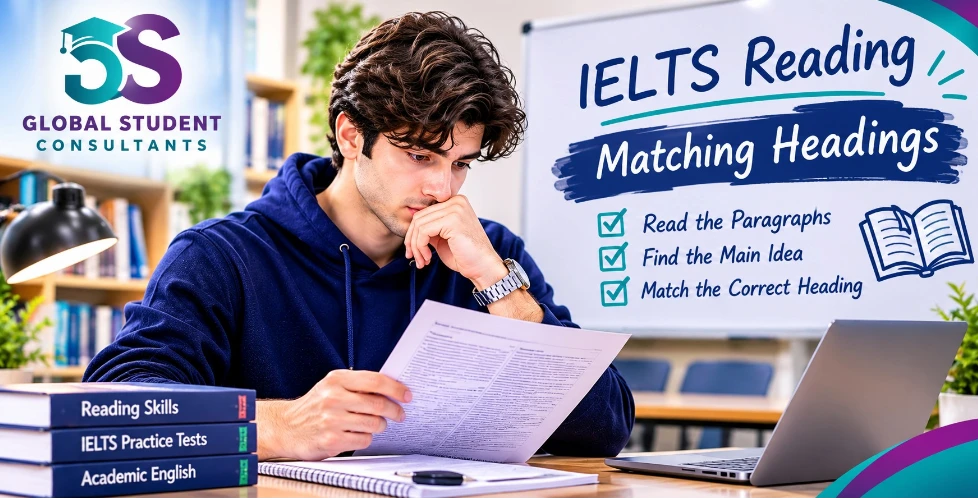
IELTS Reading Matching Headings can be challenging when students focus on matching words instead of understanding the main idea of each paragraph. The key to getting better results is learning how to identify the central message in just two or three words.
You may find the same word in a paragraph and a heading and feel confident about your answer. However, this can be a trap. IELTS often uses similar vocabulary in incorrect headings to test whether you understand the paragraph or are simply matching words.
At GS Consultant, we encourage students to develop effective IELTS reading strategies that improve accuracy, time management, and overall test performance. In this guide, you will learn six practical steps to solve IELTS Reading Matching Headings questions, identify common mistakes, practise with examples, and follow a five-day preparation plan.
Do not match words. Read each paragraph, summarise its main idea in two or three words, then choose the heading with the same meaning, even if the vocabulary is completely different. Solve the easy paragraphs first and cross out headings as you use them.
What Is Matching Headings in IELTS Reading?
Matching Headings is a question type in the IELTS Reading test where you match a list of headings with the correct paragraphs in a passage. Each paragraph has a letter, such as A, B, C, or D, while the headings are usually written using Roman numerals. Your task is to identify the heading that best represents the main idea of each paragraph. The IELTS Reading test includes:
- 60 minutes to complete the test
- 40 questions across three passages
- One mark for every correct answer
- Extra headings that may not be used
The most important thing to remember is that Matching Headings tests your understanding of the overall meaning rather than your ability to find identical words.
Why Do Students Lose Marks in IELTS Matching Headings?
Many students lose marks because they focus too much on familiar vocabulary. For example, imagine a paragraph discussing how introducing bicycle rental services reduced the number of cars entering a city centre. A heading about the popularity of bicycle rentals may look correct because the paragraph mentions bicycles. However, the main idea is actually the surprising reduction in car use. This is why identifying the central message is more important than recognising individual words. Some common reasons students make mistakes include:
- Choosing headings because they contain familiar words
- Focusing on examples instead of the main idea
- Ignoring the first and last sentences
- Spending too much time on difficult paragraphs
- Confusing Matching Headings with Matching Information
Improving your reading technique can help you avoid these mistakes and approach the IELTS Reading test with greater confidence.
The Core Strategy: Find the Main Idea With the 2–3 Word Test
One of the easiest ways to improve your IELTS Reading Matching Headings performance is to summarise each paragraph in two or three words. Follow these three steps:
- Read the paragraph carefully. Read the complete paragraph once without looking for words that match the headings. Focus on understanding the message.
- Ask yourself what the paragraph is really about. Think about the main purpose of the paragraph. Is it explaining a problem, presenting a discovery, discussing an advantage, or describing a change?
- Summarise the main idea in 2–3 words. Write a short summary before looking at the available headings.
Paragraph: Bicycle services reduced traffic.
Main idea: Reduced car use.
Possible heading: A surprising effect on car use.
This method helps you identify the correct heading even when the wording is completely different.
Remember: Matching Headings mein sirf lafzon ki mumasilat nahi dhoondni. Paragraph ka markazi khayal samajhna hota hai.
Step by Step: How to Answer Matching Headings
Follow these six steps whenever you practise IELTS Reading Matching Headings questions.
- Read the instructions. Check how many paragraphs and headings are provided. Look for any example answer and confirm whether each heading can be used only once.
- Scan the headings. Read the list of headings before matching them. Underline the important words and understand what each heading is describing.
- Summarise each paragraph. Read one paragraph at a time and write its main idea in two or three words. Avoid selecting a heading immediately after finding a familiar word.
- Match by meaning. Compare your short summary with the available headings and select the one that best represents the entire paragraph. The correct heading may use completely different vocabulary.
- Cross out incorrect options. Remove headings that clearly do not match. If you cannot decide between two options, mark the paragraph and continue.
- Check your answers. Return to the unanswered paragraphs and review your selections. Make sure every answer is recorded correctly before moving to the next task.
Solving easier paragraphs first can make difficult questions easier, because fewer headings remain. Cross out each heading as you use it.
How to Understand Paraphrasing in Matching Headings
IELTS frequently uses paraphrasing to make Matching Headings questions more challenging. The words are different, but the underlying meaning remains the same.
| Paragraph wording | Possible heading |
|---|---|
| Cars entering the city decreased. | A reduction in traffic |
| Experiments disproved an old belief. | A common belief challenged |
| Night opening attracted visitors but increased expenses. | Benefits and drawbacks |
To improve your paraphrasing skills:
- Learn synonyms and alternative expressions
- Practise identifying similar meanings
- Focus on the overall message
- Avoid depending on identical vocabulary
- Understand how linking words change the direction of a paragraph
Practise IELTS Matching Headings With These Examples
The following short exercises can help you develop the habit of identifying main ideas. Read each paragraph, think of your own two-to-three-word summary, and then compare it with the main idea shown.
Paragraph 1
Many cafés now charge extra for takeaway cups. Customers who bring their own mugs pay less, and recycling bins are no longer overflowing.
Main idea: Reducing disposable waste.
Paragraph 2
In the 1990s, only a small number of households owned computers. By 2010, computer ownership had increased significantly, and schools started moving homework online.
Main idea: Growth in computer ownership.
Paragraph 3
Some people believe goldfish can remember things for only three seconds. However, scientific experiments have shown that they can learn routes and recognise feeding times.
Main idea: Challenging common beliefs.
Paragraph 4
A museum introduced evening opening hours to attract younger visitors. Although attendance increased, electricity expenses also increased and employees had to work longer hours.
Main idea: Advantages and disadvantages.
Practising exercises like these can improve your ability to recognise the central message of different paragraphs.
Four Common IELTS Matching Headings Traps
Understanding common mistakes can help you avoid losing easy marks.
| Common trap | Why it is confusing | How to avoid it |
|---|---|---|
| Word matching | A heading repeats a word from the paragraph. | Check the overall meaning. |
| Detail heading | It matches only one example. | Focus on the entire paragraph. |
| Too broad or narrow | The heading does not cover the correct scope. | Compare the heading with your summary. |
| Two similar headings | Both options appear possible. | Compare which one represents the main idea more accurately. |
Do not select an answer simply because it looks familiar. Always check whether it represents the complete paragraph.
What to Do When You Get Stuck on a Paragraph
Sometimes, even after reading carefully, you may struggle to identify the correct heading. Instead of spending several minutes on one question, follow this approach:
- Read the first and last sentences again
- Identify linking words such as however, although, but, and therefore
- Reduce your options to two possible headings
- Compare both headings with the paragraph’s central message
- Mark the question and return to it later if necessary
This approach helps you manage your time and avoid getting stuck on difficult questions.
How to Improve IELTS Matching Headings at Home: A 5-Day Practice Plan
Consistent practice is one of the best ways to improve your IELTS Reading skills. Follow this simple five-day plan:
- Day 1: Identify main ideas. Read five short paragraphs from different articles. Summarise each paragraph in two or three words.
- Day 2: Understand topic sentences. Practise identifying the sentences that communicate the main message of each paragraph.
- Day 3: Find common traps. Complete a solved Matching Headings exercise and identify why the incorrect options looked attractive.
- Day 4: Improve paraphrasing. Rewrite five headings using different vocabulary while keeping their original meanings. Also revise IELTS grammar and vocabulary to improve your understanding of complex sentences.
- Day 5: Complete a timed practice test. Attempt one IELTS Reading passage within approximately 20 minutes. Review your mistakes and identify the areas that need improvement.
Use authentic IELTS practice materials, including Cambridge IELTS books, to become familiar with the examination format.
How Much Time Should You Spend on Matching Headings?
The IELTS Reading test gives you 60 minutes to complete 40 questions across three passages. As a general guideline, you can allocate approximately 20 minutes to each passage. However, your timing may vary depending on the difficulty of the questions. To manage your time effectively:
- Avoid spending too long on one paragraph
- Solve easier questions first
- Do not read the same paragraph repeatedly without a purpose
- Use the two-to-three-word summary technique
- Leave time to review unanswered questions
Practise using the same format you intend to take, whether computer-delivered or paper-based IELTS.
How Matching Headings Skills Help in Other IELTS Modules
The ability to identify and understand main ideas is useful beyond the Reading test.
IELTS Listening
Understanding paraphrasing helps you recognise answers even when speakers use different vocabulary from the questions.
IELTS Speaking
Planning your ideas in two or three words can help you organise your answers and speak more confidently.
IELTS Writing
Identifying central ideas makes it easier to organise paragraphs, develop arguments, and maintain a clear structure.
Developing these skills together can contribute to more effective IELTS preparation.
Prepare for IELTS With GS Consultant
Preparing for IELTS requires more than learning vocabulary and completing practice tests. Students need the right techniques, consistent guidance, and regular feedback to improve their performance. GS Consultant supports students with IELTS preparation and study-abroad guidance. Our aim is to help students strengthen their English language skills and prepare for their international education journey. With structured preparation, students can work on:
- IELTS Reading techniques and question-solving strategies
- Listening practice and answer identification
- Writing Task 1 and Task 2 structure
- Speaking fluency and confidence
- Grammar, vocabulary, and paraphrasing
- Practice tests and performance improvement
If you are struggling with Matching Headings, guided practice can help you identify your mistakes and develop a more effective approach. Contact GS Consultant to learn about IELTS preparation options in Lahore and online.
IELTS Reading Matching Headings FAQs
1. What is Matching Headings in IELTS Reading?
Matching Headings is a question type in which you match each paragraph with the heading that best represents its main idea. Usually, there are more headings than paragraphs.
2. Why do I get Matching Headings questions wrong?
Students often choose answers based on similar words instead of understanding the paragraph’s overall meaning. Focusing on the central idea can help reduce these mistakes.
3. Should I read the headings or paragraphs first?
You can quickly scan the headings first to understand the available options. Then read each paragraph and summarise its main idea before selecting an answer.
4. How can I find the main idea quickly?
Read the paragraph carefully, pay attention to its first and last sentences, and identify the message repeated or developed throughout the paragraph.
5. Can I understand the main idea in Urdu first?
Yes. If thinking about the main idea in Urdu helps you understand the paragraph, you can use it as a learning technique. However, practise recognising the meaning directly in English as your skills improve.
6. How can I improve my IELTS Reading score?
Practise different question types, improve vocabulary, understand paraphrasing, and complete timed Reading tests regularly.
Final Thoughts: Focus on Ideas, Not Words
IELTS Reading Matching Headings becomes easier when you understand what each paragraph is actually communicating. Instead of searching for identical words, focus on the central message. Summarise every paragraph in two or three words, compare its meaning with the headings, and avoid common traps. Regular practice and the right preparation strategy can help you become more accurate and confident in the IELTS Reading test.
If you need professional IELTS preparation support, contact GS Consultant in Lahore to explore available guidance and take the next step towards your study-abroad goals.
Need help with IELTS Reading?
Contact GS Consultant for IELTS preparation guidance in Lahore and online.
Contact GS ConsultantGS Consultant – Lahore, Pakistan