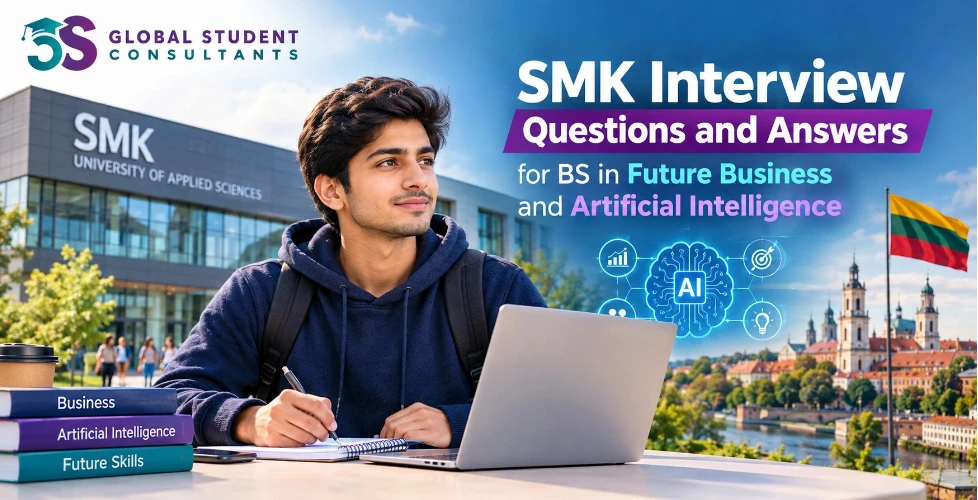
Every year, many Pakistani students apply to SMK College of Applied Sciences in Lithuania to pursue higher education. However, some applicants face rejection during the motivational interview, even when they have good academic records. The main reason is that SMK’s interview process is not designed to test academic knowledge alone. Instead, it focuses on the student’s motivation, future ambitions, understanding of the selected programme, and genuine intention to study abroad.
This article is based on an actual interview experience of a student who applied for the BS in Future Business and Artificial Intelligence programme at SMK. We have covered the questions asked during the interview, what the admission team expects from applicants, and how you can prepare effective answers.
If you are planning to study in Lithuania from Pakistan, these SMK interview questions and answers will help you understand the interview process and approach it with greater confidence.
The SMK motivational interview is an online interview on Google Meet that tests your motivation, programme knowledge, communication, and financial readiness, not your academic knowledge. Answer in your own words, keep every answer consistent with your application, and avoid memorised responses.
What Is the SMK Motivational Interview?
Once you complete your application and pay the required application fee, SMK College of Applied Sciences may invite you to attend an online motivational interview. According to the college’s admission information, these interviews are conducted through Google Meet.
The purpose is to understand your reasons for choosing the programme, evaluate your communication skills, and assess whether you have a realistic educational and career plan. Applicants generally receive an admission decision within a few days after the interview.
After receiving an acceptance, students are required to pay the initial tuition instalment to secure their admission. The published annual tuition fee for the BS in Future Business and Artificial Intelligence programme has been approximately €3,400 for non-EU students. The programme is a three-year professional bachelor’s degree. However, applicants should verify the latest tuition information directly with SMK before making financial arrangements.
It is also important to understand the current immigration procedure. Although many Pakistani applicants still use the term Lithuania student visa, SMK’s admission guidance indicates that international students must follow the temporary residence permit (TRP) route rather than the previous student visa process. Students should confirm the latest application procedure and submission arrangements before applying.
Review your complete admission application before the interview. Your spoken answers should be consistent with your academic documents, personal statement, financial information, and other details submitted to SMK.
Real SMK Interview Questions for Future Business and Artificial Intelligence
The following questions are taken from an actual interview experience of a student applying for the BS in Future Business and Artificial Intelligence. We have explained the purpose behind each question and provided guidance on how to structure your response. Remember that these are preparation examples, not fixed answers. Your responses should reflect your actual background, experience, and future plans.
1. Can You Introduce Yourself?
This is usually one of the opening questions in an SMK motivational interview. The interviewer wants to understand your educational background and get a general idea of your personality and communication skills.
Keep your introduction short, preferably between 30 and 45 seconds. Include your name, hometown, previous education, intended degree, and a brief explanation of your interest in studying in Lithuania. Avoid repeating everything written in your CV. Instead, introduce yourself naturally and confidently in clear English.
2. You Have Mentioned Your Family Business. Can You Explain What It Does?
If you have included a family business in your application, the interviewer may ask you to provide further information about it. Be prepared to explain:
- What products or services the business provides
- How long it has been operating
- How many people are working there
- Who manages its daily operations
- Any responsibilities you have in the business
Instead of simply saying that your family is involved in trading, explain the actual nature of the business, its location, the number of employees, and your involvement. This question is particularly important if you have explained in your application that your selected degree will help you develop or expand the family business. Make sure your answers match the information already provided in your application.
3. How Can This Degree Help You Grow Your Family Business?
This question evaluates whether you understand the relationship between your chosen programme and your future professional goals. The BS in Future Business and Artificial Intelligence combines business knowledge with modern technological applications. You should understand how subjects such as business analytics, artificial intelligence, business innovation, and data protection can support your career.
For example, you could explain how business analytics can help identify customer preferences, forecast product demand, and improve business decisions. You may also discuss how AI-based tools could improve customer services, digital marketing, inventory management, and other business activities. Your answer should demonstrate that you selected the programme for a clear reason rather than simply choosing an available bachelor’s degree.
4. Do You Think Integrating Artificial Intelligence into Businesses Can Be Harmful?
The interviewer is interested in your ability to evaluate both the advantages and disadvantages of artificial intelligence. Avoid presenting AI as a technology that has only positive effects. A balanced response should recognise some of the possible concerns, including:
- Job displacement due to automation
- Privacy and data security concerns
- Biased decisions made by AI systems
- Excessive dependence on automated technology
- Ethical challenges in business applications
You can then explain that artificial intelligence should be introduced responsibly, with appropriate human supervision and data protection measures. For example, businesses can use AI to support employees, improve productivity, and analyse information without completely replacing human decision-making. Understanding these issues also shows awareness of the AI ethics and data protection aspects of your selected programme.
5. What Problems Does Your Business Face, and What Are the Major Challenges in Pakistan?
This question assesses your understanding of business conditions and the economic environment in your home country. Try to discuss a few genuine challenges rather than giving an unnecessarily long explanation.
For a family business, possible examples include increasing operational expenses, difficulties in maintaining financial records, limited digital marketing, and changing customer demands. When discussing Pakistan, you may mention inflation, currency fluctuations, rising electricity costs, and economic uncertainty. Explain these challenges professionally and avoid making unnecessarily negative statements about your country. The interviewer wants to see whether you understand real-world problems and can think about practical solutions.
6. Did You Explore Other Countries Before Choosing Lithuania?
Students are generally expected to research different international study destinations before making their final decision. You can honestly explain whether you considered countries such as the UK, Germany, Poland, or other European destinations. However, your response should clearly explain why Lithuania became your preferred option. Some relevant points may include:
- An English-taught bachelor’s programme
- A curriculum combining business and artificial intelligence
- European educational exposure
- Tuition fees that fit your financial circumstances
- Opportunities to develop international business knowledge
Avoid general statements such as “Lithuania is simply a good country.” Explain how the university and programme match your personal educational objectives.
Do not learn answers word for word. Interviewers may ask additional questions based on your responses, so understanding your own application is much more important than memorising prepared statements.
7. Why Have You Selected Lithuania Instead of Studying in Pakistan?
This is an important question because the interviewer wants to understand your reasons for choosing an international education. Avoid saying that Pakistan has no educational opportunities or that you cannot build a successful career in your home country.
Instead, discuss the specific benefits of your selected programme at SMK. For example, you can mention its combination of business and artificial intelligence, practical learning approach, international educational environment, and exposure to European business practices. Explain how the knowledge and experience gained through this degree will contribute to your long-term career plans. Your answer should show that your decision is based on educational and professional objectives rather than simply wanting to move abroad.
8. What Cultural Differences Do You Expect to Experience in Lithuania?
The interviewer wants to know whether you have researched Lithuanian culture and understand that living in another country requires adjustment. You can discuss several differences that you may experience, such as:
- Colder weather compared with Pakistan
- Different food preferences and eating habits
- Differences in communication and social behaviour
- Greater emphasis on punctuality
- A different educational and workplace environment
Also explain how you intend to adjust, for example by learning some basic Lithuanian expressions, interacting with international students, respecting local traditions, and becoming familiar with the country’s lifestyle. This demonstrates that you have considered the practical side of studying abroad.
9. How Will You Manage Your Expenses While Living in Lithuania?
This question is mainly about your financial preparation. The interviewer wants to establish whether you have sufficient financial support to pay your tuition fees and manage your daily living expenses. Clearly explain who will finance your education. Your sponsor could be your parents, another family member, personal savings, or income from a family business. You should also have a realistic understanding of the expenses involved, including:
- Monthly accommodation
- Food and groceries
- Local transportation
- Health insurance
- Personal and educational expenses
Be prepared to explain your approximate monthly budget and the financial resources available to you. Do not present part-time employment as your primary source of funding. Your education and living expenses should be supported by a realistic financial plan.
10. Which City Will You Live In, and How Much Money Will You Need for Accommodation and Other Expenses?
SMK has campuses in Vilnius, Kaunas, and Klaipėda. Depending on your selected programme and study arrangements, you should know the city where you intend to study. The interviewer may ask about your accommodation plans and the estimated cost of living.
As a general planning estimate, students may need approximately €500–€800 per month for accommodation, food, transportation, and other basic expenses. Actual costs depend on the city, accommodation type, and personal lifestyle. Vilnius may require a higher budget than some smaller Lithuanian cities, and shared accommodation can help reduce monthly expenses. Before attending your interview, research actual accommodation options and prepare a reasonable breakdown of your expected expenses.
11. What Interesting or Unique Thing Have You Learned About Lithuania?
This question helps the interviewer understand whether you have made a genuine effort to research your chosen study destination. Rather than giving a general introduction to Lithuania, select one or two interesting facts and explain why they attracted your attention. For example, you could discuss:
- Lithuania’s growing fintech and startup sector
- Its well-developed internet infrastructure
- Vilnius Old Town and its UNESCO World Heritage status
- Lithuania’s membership of the European Union
- Its international business and technology environment
Choose information that connects with your academic interests or future professional plans. For a student applying to Future Business and Artificial Intelligence, discussing Lithuania’s developing technology and startup environment could make your response more relevant.
SMK Interview Questions: Quick Preparation Table
The table below summarises some of the major interview questions and the qualities SMK may evaluate through them.
| No. | Interview Question | What the Interviewer Evaluates | What Your Answer Should Demonstrate |
|---|---|---|---|
| 1 | Introduce yourself | Communication skills | A clear and organised introduction |
| 2 | Explain your family business | Credibility | Accurate and specific information |
| 3 | How will this degree help your business? | Programme understanding | Relevant academic and career goals |
| 4 | Why Lithuania instead of Pakistan? | Study motivation | Genuine educational reasons |
| 5 | How will you manage your expenses? | Financial preparation | A reliable funding arrangement |
| 6 | Which city will you live in? | Destination research | Accommodation and budget awareness |
| 7 | What interests you about Lithuania? | Genuine interest | Knowledge of the country |
Students applying to Klaipėda University can explore our separate interview guide for additional preparation tips and commonly discussed admission questions.
How to Successfully Pass the SMK Motivational Interview
Passing the SMK motivational interview requires more than speaking English confidently. You must demonstrate that you understand your selected programme, have realistic expectations, and know why you want to pursue higher education in Lithuania. Here are some practical ways to prepare.
- Review your application. Read your submitted application, personal statement, academic documents, and financial details. Make sure you can explain every important detail without hesitation.
- Understand your selected programme. Research the BS in Future Business and Artificial Intelligence. Learn about its duration, subjects, tuition fees, and the knowledge you expect to gain.
- Prepare your future goals. Be ready to explain how the degree relates to your intended career. If you have a family business, understand how your education could contribute to its development.
- Practise speaking in English. Practise answering questions aloud. Ask a friend or counsellor to conduct a mock interview and introduce unexpected follow-up questions.
- Research Lithuania. Learn about your selected campus, accommodation options, estimated living expenses, culture, and educational environment.
- Check your technical setup. Arrange a stable internet connection, a quiet room, a fully charged laptop, and a properly working camera and microphone.
- Keep your documents ready. Keep your passport and relevant application documents nearby in case the interviewer asks you to confirm any information.
- Maintain professional behaviour. Dress appropriately, sit in a quiet environment, look towards the camera, and speak at a comfortable pace. If you do not understand a question, politely ask the interviewer to repeat it.
Most importantly, avoid memorised responses. A natural answer based on your actual experience is more convincing than a perfectly rehearsed statement that you cannot explain further.
Practise with a mock interview and ask your partner to add unexpected follow-up questions. If you can explain every detail of your own application calmly, you are well prepared.
Common Reasons Students Fail the SMK Interview
Even students with good academic qualifications may struggle during the motivational interview if they cannot explain their study plans or provide consistent information. These are the most common mistakes.
| No. | Common Interview Mistake | Why It Can Cause Problems |
|---|---|---|
| 1 | Memorising answers from online sources | Responses sound unnatural and become difficult to explain during follow-up questions |
| 2 | Providing unclear family business information | Creates doubts about the accuracy of the application |
| 3 | Giving negative opinions about Pakistan | Makes the student’s educational motivation appear unclear |
| 4 | Having unrealistic living cost estimates | Indicates insufficient preparation for studying abroad |
| 5 | Giving answers that contradict submitted documents | Raises concerns about the student’s credibility |
| 6 | Having limited knowledge of the selected programme | Suggests that the student has not researched the degree properly |
These mistakes are generally related to preparation, communication, and consistency rather than academic ability. Students can reduce the risk of interview problems by reviewing their applications, researching the programme, and practising honest responses before the scheduled interview.
Also read: Lithuania Spouse Visa from Pakistan: Complete 2027 Guide. If you are planning to relocate with your spouse, explore the relevant family immigration options and understand the requirements before making your plans.
Get Professional Assistance for Your SMK Interview Preparation
Preparing for an international university interview can be challenging, particularly when you are applying from Pakistan and are unfamiliar with the admission procedure. Global Migration Advisors supports Pakistani students throughout their journey to study in Lithuania. Our team provides guidance on programme selection, university applications, document preparation, mock SMK interviews, financial documentation, and the temporary residence permit application process.
We also help students understand the admission requirements and prepare for questions related to their academic backgrounds, selected programmes, and future career objectives. If you need assistance with English language preparation, our team also offers IELTS coaching. Visit globalmigration.pk or contact Global Migration Advisors to discuss your study plans and receive guidance before your SMK interview.
What Happens After You Pass the SMK Interview?
Once SMK approves your application, you will receive further admission instructions. The next step generally involves paying the required initial tuition instalment to confirm your place in the programme. After completing the university’s admission requirements, you can proceed with the applicable temporary residence permit (TRP) application.
Students should carefully follow the latest instructions provided by SMK and the relevant Lithuanian immigration authorities regarding application submission, supporting documents, and appointment arrangements. SMK’s guidance indicates that students may need to travel to Lithuania after receiving their residence permit and complete the required study contract formalities there.
Processing periods can vary depending on the application route and individual circumstances. Therefore, arrange your documents early and avoid booking non-refundable travel before receiving the necessary approval.
FAQs: SMK Interview Questions and Answers
1. What is the SMK motivational interview?
The SMK motivational interview is an online assessment conducted through Google Meet. It helps the college evaluate an applicant’s motivation, educational interests, communication skills, and understanding of the selected programme.
2. Is the SMK motivational interview an academic examination?
No. The interview is primarily intended to assess your study motivation, personal background, programme knowledge, and future objectives rather than test your academic knowledge through a formal examination.
3. How is the SMK interview conducted?
SMK conducts its motivational interviews online through Google Meet. Applicants should arrange a stable internet connection, a working camera and microphone, and a quiet environment.
4. How long does SMK take to announce the interview decision?
Applicants are generally informed of the decision within a few days, although the actual timeline may vary depending on the application and admission process.
5. What is the tuition fee for BS in Future Business and Artificial Intelligence at SMK?
The published annual tuition fee for non-EU students has been approximately €3,400 for this three-year bachelor’s programme. Students should confirm the latest fee directly with SMK before applying.
6. What should I prepare before my SMK interview?
You should review your application, understand your selected programme, prepare your future career plans, research Lithuania, and have a clear financial arrangement. You should also practise speaking naturally in English.
Final Thoughts
The SMK motivational interview is an important stage in the admission process for students applying to the BS in Future Business and Artificial Intelligence programme. Success depends on how well you understand your selected degree, explain your reasons for choosing Lithuania, demonstrate financial readiness, and communicate your future ambitions.
Students who prepare their applications carefully and practise answering questions in their own words can approach the interview with greater confidence. If you are planning to study in Lithuania from Pakistan, start preparing early instead of waiting until the interview invitation arrives. Research SMK, understand the programme, organise your documents, and make sure your answers reflect your genuine intentions.
Need help preparing for your SMK interview?
Contact Global Migration Advisors for professional guidance with university applications, interview preparation, and the Lithuania student residence permit process.
Contact Global Migration AdvisorsGlobal Migration Advisors | Lahore, Pakistan | globalmigration.pk