Studying medicine overseas is a big financial commitment. International students in the UK can face tuition running into tens of thousands of pounds each year, and private medical colleges in Pakistan add hostel costs and extra charges on top of their fees.
So what is the cheapest country to become a doctor? There is no single answer. It depends on tuition, living costs, course length, safety, university recognition, and the licensing rules you must meet after graduation.
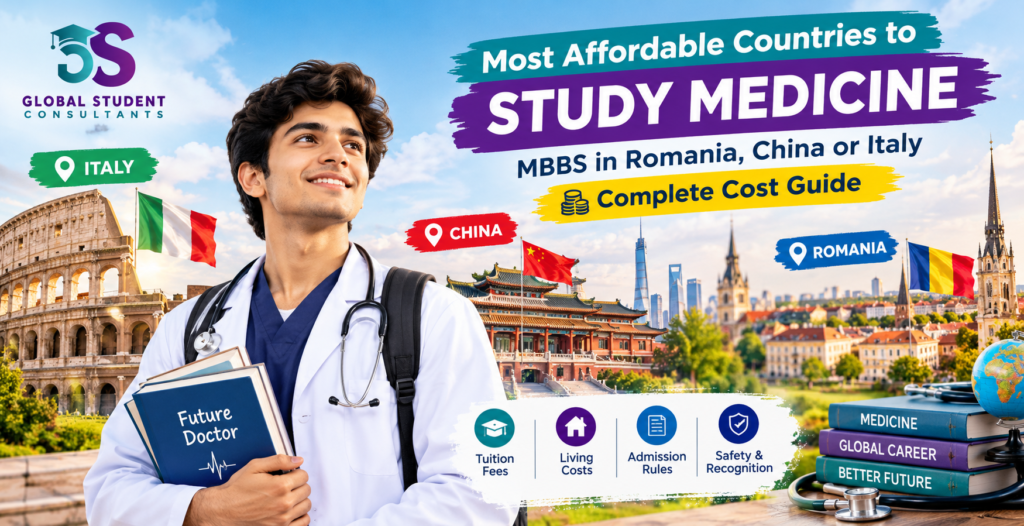
Pakistani students usually compare three destinations: MBBS in Italy, MBBS in China and MBBS in Romania. Italy can have very low public-university fees, China is known for affordable English-taught programmes, and Romania lets you study medicine inside the European Union. This guide sets out their costs, admission rules, advantages and risks side by side.
Quick Cost Snapshot
- China: roughly $3,000–$7,000 per year in tuition at some universities.
- Romania: roughly €7,000–€10,000 per year.
- Italy: public universities may charge about €156–€4,500 per year, depending on the university and your eligibility for reductions.
- Pakistan: private medical colleges can reach PKR 2 million or more per year.
- Course length: most medical degrees take five to six years, sometimes with an internship included.
What Does an Affordable Medical Degree Really Cost?
The cheapest medical university is not always the one with the lowest advertised tuition. You need to price the whole journey, from your first semester to your licence.
Because a medical course lasts several years, a small yearly difference grows into a large gap by graduation. A university with low tuition may have costly housing or extra administrative charges. Another may charge more but give you predictable fees, better student support and a clearer path to registration.
Pakistani students must also confirm that the university and degree satisfy the current rules of the Pakistan Medical and Dental Council (PM&DC). Check this before paying any application fee or deposit.
Cheapest Countries to Study Medicine: Side-by-Side Comparison
| Country | Estimated yearly tuition | Language | Duration | Main thing to watch |
|---|---|---|---|---|
| Italy | About €156–€4,500 (some public universities) | English in selected programmes | 6 years | Tough admission, limited non-EU seats |
| Kyrgyzstan | About $2,000–$7,000 | Varies by university | Confirm full structure | Recognition, clinical training and safety |
| China | About $3,000–$7,000 (some universities) | English in approved programmes | Usually 6 years with internship | University eligibility and PM&DC rules |
| Romania | About €7,000–€10,000 | English in selected programmes | 6 years | Higher tuition than some options |
| Pakistan (private) | PKR 2 million or more | English | 5 years plus house job | Fee caps, extra charges, competition |
Fees change by institution, year, programme and student category. Always rely on official university information for your own budget.
MBBS in China: Affordable English-Taught Medicine
Many Pakistani families consider MBBS in China because several Chinese medical universities teach in English at relatively low tuition, often around $3,000–$7,000 a year. Housing and daily expenses differ by city and lifestyle, so keep a separate living budget instead of relying on the tuition figure alone.
The programme usually runs six years including the internship, though the exact structure depends on the university.
Why Students Pick China
- Lower tuition: some universities cost far less than medical schools in many Western countries.
- English-medium teaching: eligible international students can join approved English programmes.
- Dormitories: on-campus housing can ease accommodation costs.
- Scholarships: government, provincial and university awards may exist, subject to eligibility and competition.
- Student community: some universities already support many Pakistani and other international students.
Checks Before You Apply
Not every Chinese university offers the same quality or accepts international students for English-medium medicine. Confirm that your chosen institution is authorised for the programme and that its degree meets current requirements for Pakistani graduates. Also verify admission criteria, internship arrangements, the language used in clinical training, visa rules, insurance and any entrance test for your intake.
Read our guide to MBBS in China and the steps for PM&DC registration after MBBS in China. Before committing, get written confirmation of the university’s current eligibility and registration requirements from the relevant authorities.
MBBS in Romania: A Medical Degree in Europe
MBBS in Romania suits Pakistani students who want to study medicine in Europe. Several Romanian universities teach in English, and the standard degree takes six years. Tuition usually sits between €7,000 and €10,000 a year.
For instance, Grigore T. Popa University of Medicine and Pharmacy in Iași listed €8,500 per year for international medicine students in 2025–2026. Check the university’s current fee page before relying on that number. At €7,000–€10,000 a year, six years of tuition comes to roughly €42,000–€60,000, and housing, food, insurance and travel are extra.
Advantages of Studying in Romania
- English programmes: selected universities teach medicine in English.
- EU setting: you study inside a European Union member state.
- Published fees: official schedules make budgeting easier.
- International experience: several medical universities are used to foreign students.
- Predictable structure: a clear six-year plan helps families spread the cost.
Recognition Is Not Automatic
A Romanian degree can open doors in Europe, but the right to practise is not granted everywhere automatically. Graduates must meet the registration, licensing and language rules of the country where they want to work, and Pakistani students should separately confirm current PM&DC requirements for their university.
Explore our pages on MBBS in Romania, MBBS in Romania fees and the best Romanian universities for medicine.
MBBS in Italy: Low Public Fees, Tough Admission
MBBS in Italy can be among the cheapest routes to a medical degree if you win a place at a public university and qualify for lower fees. Some public universities running English-taught medicine charge roughly €156–€4,500 a year, depending on their policy, your income documents and eligible reductions. Private medical universities cost much more, often around €15,600–€21,000 a year or higher.
Medicine in Italy normally lasts six years. Cheap tuition does not make the whole degree cheap, so budget for housing, food, transport, insurance and visa costs as well.
Why Italy Can Cost So Little
Public fees often depend on the university’s fee structure and your documented family finances. Eligible students may also receive scholarships or other aid, which makes Italy attractive for families who qualify and can cover living costs abroad.
The Big Hurdle: Getting In
Seats in English-taught medicine at Italian public universities are highly competitive. The entrance test, selection process, seat numbers and eligibility rules change with the academic year and university. The International Medical Admissions Test (IMAT) has been used in the past, but for 2026–2027 you should read the current official admission notice rather than assume earlier procedures still apply.
Non-EU applicants may face separate seat quotas and application rules. Miss a deadline or fall short of the selection criteria and you may have to wait for another intake.
How Pakistani Students Can Apply to Italy
- Check eligibility. Make sure your FSc or equivalent meets the university’s academic criteria.
- Read the selection rules. Review the official notice for tests, registration dates and seats.
- Complete pre-enrolment. Follow the instructions on the official Universitaly portal.
- Prepare academic papers. Arrange certificates, transcripts, attestations and translations.
- Gather financial documents. Fee reductions may require specific income and asset records.
- Apply for the student visa. Prepare financial proof, accommodation details, insurance and the other listed documents.
- Finish arrival formalities. Complete residence-permit and university registration steps.
Depending on the university and your situation, you may also need a Declaration of Value or a CIMEA statement. Confirm exact requirements before arranging them.
Other Low-Cost Countries Students Consider
Pakistani students sometimes look at Kyrgyzstan, Uzbekistan, Kazakhstan, Georgia and Russia. Some universities there advertise low fees, but standards vary widely, so never choose a university just because its fees or entry rules look easy. Before applying, ask:
- Does the university and degree meet current PM&DC requirements?
- Is the programme really taught in the advertised language?
- How are clinical placements and hospital training arranged?
- What must graduates do to get a licence in Pakistan?
- Is suitable housing and student support available?
- What is the full cost once insurance, travel and hostel fees are added?
- What does current official travel advice say about student safety?
Safety Matters: The May 2024 Bishkek Violence
In May 2024, foreign students in Bishkek, Kyrgyzstan, were attacked after a video of a fight between local and foreign students spread widely. Pakistani students were among those affected, and Pakistani authorities helped those who wished to return home. Studies were disrupted and many families were alarmed.
This does not describe daily life for every student in Kyrgyzstan, but it shows why safety planning belongs in your decision. Before accepting an offer, read current embassy advice, ask about hostel security, learn the university’s emergency procedures and find out what support exists if classes are interrupted.
Recognition and Licensing for Pakistani Students
A foreign medical degree does not automatically entitle you to practise in Pakistan. Verify the current PM&DC rules, including whether your chosen foreign institution is eligible and what licensing process applies. Depending on the rules in force at graduation, you may need extra exams, registration, an internship or additional paperwork.
Ask These Before Paying a Deposit
- Is the university currently eligible under PM&DC rules?
- Does the programme meet the required educational standards?
- What clinical training will students actually receive?
- Which exams or licensing steps follow graduation?
- Are there extra fees for exams, internships or registration?
- What happens if the university changes its programme or eligibility?
Which Country Fits Your Budget?
The best destination depends on your finances, grades, preferred study environment and long-term plans.
| Your priority | Consider | Why |
|---|---|---|
| Lower tuition at selected English-medium universities | China | Several universities charge comparatively affordable fees |
| A European medical education | Romania | English-taught medicine inside the EU |
| Possibly very low public tuition | Italy | Eligible students may get income-based fees or aid |
| Exploring more low-cost options | Kyrgyzstan and others | Fees can be low, but recognition and safety need careful checking |
Treat these as research starting points, not proof that one country is cheapest for every student.
Plan Your MBBS Budget in Five Steps
Step 1: Work Out the Total Budget
Multiply yearly tuition by the full course length, then add housing, food, transport, insurance, visa costs, flights, document preparation and expected licensing fees. Never plan around first-year fees alone.
Step 2: Shortlist Two or Three Countries
Compare China, Romania, Italy and other suitable options against your grades and finances. Keeping alternatives open helps if admission rules, seats or visa timelines change.
Step 3: Verify Recognition
Check the university’s current status and PM&DC requirements before any deposit. Get fees, course duration, internship arrangements and extra charges in writing.
Step 4: Prepare Your Documents
Collect certificates, transcripts, your passport and any medical, police, financial or sponsorship documents. Arrange attestation and translation where needed, and follow the official checklist for your application.
Step 5: Apply and Prepare for the Visa
Apply before the official deadline and keep your academic, financial and sponsorship papers accurate and consistent. Start the visa process early so you have time to fix missing documents or answer extra requests.
Frequently Asked Questions
Which is the cheapest country to become a doctor?
Italy may have the lowest tuition at eligible public universities, while China offers comparatively affordable English-taught programmes. The cheapest overall choice depends on living costs, admission eligibility, course length and licensing requirements.
Is MBBS in China cheaper than MBBS in Romania?
Often yes. Some Chinese universities charge about $3,000–$7,000 a year, while Romanian tuition usually runs €7,000–€10,000. Your real cost still depends on the university, housing and other expenses.
How much does MBBS in China cost for Pakistani students?
Tuition at some universities is about $3,000–$7,000 a year. Add accommodation, food, insurance, travel, visa costs and other charges, and confirm current fees and eligibility before applying.
Is it safe for Pakistani students to study in Kyrgyzstan?
Conditions vary by place and can change. The May 2024 violence in Bishkek showed why you should review current embassy advice, check university security and understand emergency support before you travel.
Can I practise in Pakistan after studying MBBS abroad?
Possibly, if you meet the PM&DC registration and licensing requirements. Eligibility depends on current regulations and your qualification, so verify the rules for your university before you enrol.
Is MBBS in Italy really cheap for Pakistani students?
Public tuition can be low for eligible students, especially with fee reductions or aid. But admission is competitive, living costs still apply, and you must follow the entrance and visa procedures.
Is the cheapest medical university always the best choice?
No. Recognition, teaching quality, clinical training, safety, total cost and licensing eligibility matter as much as tuition. Pick the institution that supports your long-term career, not just the lowest price.
Final Thoughts
Choosing where to study medicine is a serious financial and personal decision. Italy is attractive for its potentially low public tuition, China offers affordable English-taught programmes, and Romania gives another route into European medical education. The right choice is the one that matches your full budget, grades, safety needs and plans for practising after graduation.
At Global Migration Advisors, a study abroad consultancy in Lahore, we help students explore medicine in China, Romania, Italy and beyond, from university shortlisting and admission documents to applications and student visa preparation. Before you commit, compare official fees, confirm recognition and licensing rules, and make sure your plan covers the entire programme.
Learn more at Global Migration Advisors or browse our MBBS in Romania and MBBS in China resources.
Ready to Start Your MBBS Journey?
Talk to Global Migration Advisors about your grades, budget and preferred country.
Chat with Global Migration Advisors on WhatsApp