
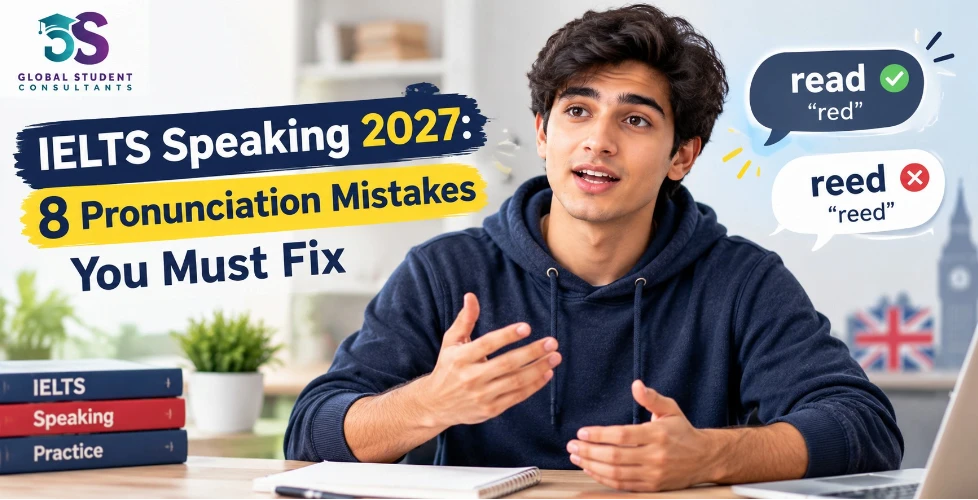
Say this line out loud: “I read it yesterday.” Did the word read come out as reed or as red? If you chose red, your ear is doing well. If you chose reed, you have just stepped into one of the trickiest traps in IELTS Speaking, a word that is written one way yet spoken two ways depending on the sentence around it. Learners at any IELTS academy in Lahore meet this trap sooner or later.
Sentence 1
I read every day.
reedSentence 2
I read it yesterday.
redThis is important because pronunciation makes up one quarter of your Speaking band, and examiners pay close attention to whether your sounds match what you mean. English is not simply a list of words to memorise. Words shift their sound depending on the sentence, and once you notice the pattern you will begin to hear it everywhere.
In this guide you will find four everyday word pairs (live, read, wind and minute), a bonus group of words whose stress moves, the sound traps that many Urdu speakers run into and a simple ten-minute daily routine. Whether you study on your own or in a classroom, say every example aloud as you go.
Why English Words Change Their Sound
In many languages the spelling tells you exactly how to say a word. English plays by different rules. One spelling can hide two or more pronunciations, and the sentence tells you which one to pick. Words like these are called heteronyms: same spelling, different sound and, most of the time, a different meaning.
So the useful question is not just “How do I say this word?” Ask instead what the word is doing in your sentence. Is it a verb or an adjective? Is the action in the present or the past? Many students preparing at IELTS institutes in Lahore find that this one habit clears up most of their confusion, because the answer leads you straight to the right sound.
4 Word Pairs Every IELTS Candidate Should Know
These four pairs appear in daily English and in the Speaking test. Pay attention to how the sentence changes the sound.
| Word | First sound | Second sound | Memory trick |
|---|---|---|---|
| Live | liv, a verb, as in “live happily” | laiv, an adjective, as in “a live TV show” | Is it happening on screen right now? Say laiv. |
| Read | reed, present: “I read every day” | red, past: “I read it yesterday” | The past tense sounds just like the colour red. |
| Wind | wind, a noun, rhymes with “pinned”: the wind is strong | waind, a verb, rhymes with “find”: wind the clock | When you turn the clock, the sound turns too: waind. |
| Minute | MIN-it, time: a minute ago | my-NYOOT, tiny: a minute detail | A tiny detail gets a tiny, sharp my-NYOOT. |
Table 1: Four pairs where the sentence changes the sound
The word stays the same on paper, but your mouth must change. Notice also that minute, in the sense of tiny, shifts its stress from the first syllable to the second, which leads neatly into the next trick.
Also readIELTS Speaking Made Easy: Simple TipsPractical ideas for building the fluency and range that examiners look for.When Stress Changes the Meaning
Sometimes the vowels stay put and the stress moves instead. In many two-syllable words, the noun carries the stress on the first syllable and the verb on the second. Capital letters below mark the stressed part.
| Word | As a noun | As a verb | In a sentence |
|---|---|---|---|
| Record | REH-cord, a record | ri-CORD, to record | She broke the record. / I record my answers. |
| Present | PREZ-ent, a present | pri-ZENT, to present | It was a lovely present. / I will present my ideas. |
| Increase | IN-creez, an increase | in-CREEZ, to increase | There was an increase in prices. / Prices increase. |
| Object | OB-ject, a thing | ob-JECT, to object | It is a strange object. / I object to that. |
Table 2: Noun and verb stress compared
Words such as increase and record come up all the time in IELTS topics, so placing their stress correctly is an easy way to sound more natural.
More Words That Switch Sounds
After you begin to notice the pattern, you will spot it everywhere. Here are six more pairs worth adding to your list, and each one is simple to test with a sentence of your own.
| Word | First sound | Second sound |
|---|---|---|
| Close | klohz, to close the door | klohs, a close friend |
| Use | yooz, to use a phone | yoos, the use of a phone |
| Lead | leed, to lead a team | led, the metal lead |
| Tear | teer, a tear from the eye | tair, to tear paper |
| Bow | bow, to bend, rhymes with now | boh, a bow on a gift |
| Wound | woond, a wound or injury | wownd, past tense of wind, rhymes with found |
Table 3: Six extra pairs for your practice list
Rhythm: The Music Behind Your Words
Single words are only part of the picture, because English also has a beat. The important words in a sentence, such as nouns, main verbs and adjectives, are stressed and clear, while small words like to, of and and are quick and light. Try saying “I want to go to the market” with the weight on want, go and market and let the rest slip by. Your speech will sound smoother at once, and a few IELTS Listening tips can sharpen your ear for this beat too.
Examiners notice rhythm even when they never mention it, and it helps your ideas move from one sentence to the next.
Why Pronunciation Counts in IELTS Speaking
Pronunciation is one of four equally weighted Speaking criteria, which makes it worth 25% of your band. Examiners listen to individual sounds, word stress, sentence stress, rhythm and intonation. They are not searching for a British or American accent. They want to follow you without effort, and that is exactly where sound-changing words matter.
Compare “I read novels” with “I read a novel last night.” On paper they look almost the same, and the only audible hint about the tense is how you say read. One slip will not ruin your band, but repeated unclear sounds make you harder to follow, and that is what holds many candidates back.
If you are aiming for band 7, clear pronunciation is part of the package. Many students wonder how hard IELTS really is, and the honest answer is that small habits like these make a bigger difference than most people expect.
Sound Traps Many Urdu Speakers Face
Apart from sound-changing words, some English sounds do not exist in quite the same way in Urdu, so they need extra care. Not every speaker has these habits, so treat the list below as a checklist and not a label.
| Sound | Common slip | Quick fix |
|---|---|---|
| V and W | “wery” for very, or vine and wine sounding identical | For V, touch your upper teeth to your lower lip. For W, round your lips. |
| The TH sounds | “tink” for think and “dis” for this | Rest the tip of your tongue lightly between your teeth and let the air flow. |
| S at the start | “iskool” for school and “istudent” for student | Begin with a clean s and glide straight on: skool. |
| Endings in -ed | Saying every -ed as “id”, as in “walkid” | Say walkt and playd, and add the extra syllable only to words like wanted. |
Table 4: Four sound traps and how to fix them
Correcting even one of these habits makes your whole answer easier to follow.
Want an expert ear on your pronunciation?
At Global IELTS and PTE in Lahore, trainers listen to your sounds, stress and rhythm the way an examiner does, and give honest feedback on every slip.
A 10-Minute Daily Pronunciation Routine
Steady practice beats last-minute cramming. Follow this loop once a day, working on one word pair at a time.
- Minute 1: Pick a pair. Choose one pair from this guide, such as live or read.
- Minutes 2 and 3: Say both versions. Read each sentence aloud and exaggerate the gap between the two sounds.
- Minutes 4 to 6: Record yourself. Use your phone and repeat each sentence three times.
- Minutes 7 to 9: Compare. Play your recording beside a dictionary audio clip and note where the sounds differ.
- Minute 10: Use it for real. Make two new sentences of your own and say them without looking.
Listening matters as much as speaking here. Reading widely also helps, because meeting these words in context makes the right sound easier to choose.
Also readIELTS Reading Part 2 PreparationA clear approach to the second Reading passage, from skimming to answering.When Practising Alone Is Not Enough
Recording yourself is useful, but it cannot always reveal which sound habits are hiding in your speech. A trainer can. If you are comparing options for coaching, browse the top 10 IELTS institutes in Lahore and look for small batches, regular mock tests and personal feedback. Be wary of anyone who guarantees a score, because no honest academy can.
If fluency and confidence are your biggest hurdles, add some general spoken English practice next to your IELTS preparation. The two work best together.
Also readBest IELTS Academy in Lahore: 2026 GuideLearn what separates a genuinely strong academy from the rest.Quick FAQs: Tap to Reveal
Does pronunciation affect my IELTS Speaking score?
Do I need a British or American accent?
How do I know which pronunciation to use?
Will one wrong word lower my band?
How long does it take to improve?
Can I practise pronunciation on my own?
Final Thoughts
English is not only about remembering words. It is about noticing how words change their sound with the sentence. Learn the pairs, watch the stress and practise a little every day, and your Speaking will sound clearer, calmer and far more confident.
Still choosing where to prepare? Compare the best IELTS and PTE coaching centres in Lahore before you decide.
Global IELTS and PTE | globalmigration.pk | Lahore, Pakistan
Chat with Global Migration Advisors